
RESOURCES
Clear Information. Trusted Guidance.
Educational resources for attorneys, insurers, and patients on independent medical examinations, impairment ratings, expert admissibility, and more.

WHAT IS AN INDEPENDENT MEDICAL EXAMINATION (IME)?
An Independent Medical Examination (IME) is an objective evaluation performed by a physician who is not involved in a claimant’s ongoing treatment. IMEs are used in workers’ compensation, personal injury, and disability cases to assess diagnosis, causation, treatment necessity, and permanent impairment.
Unlike a treating physician, an independent medical examiner has no ongoing relationship with the patient. Their role is limited to reviewing medical records, conducting a physical examination, and issuing an objective opinion based on the medical evidence. This objectivity is what makes an IME useful in litigation — attorneys, insurers, and courts rely on IME findings precisely because the examining physician has no stake in the outcome of the claimant’s treatment.
Dr. Idema, an actively practicing orthopedic and spine surgeon, brings current clinical and surgical expertise to every IME she conducts — a distinction from retired or non-operating physicians who perform IMEs exclusively.

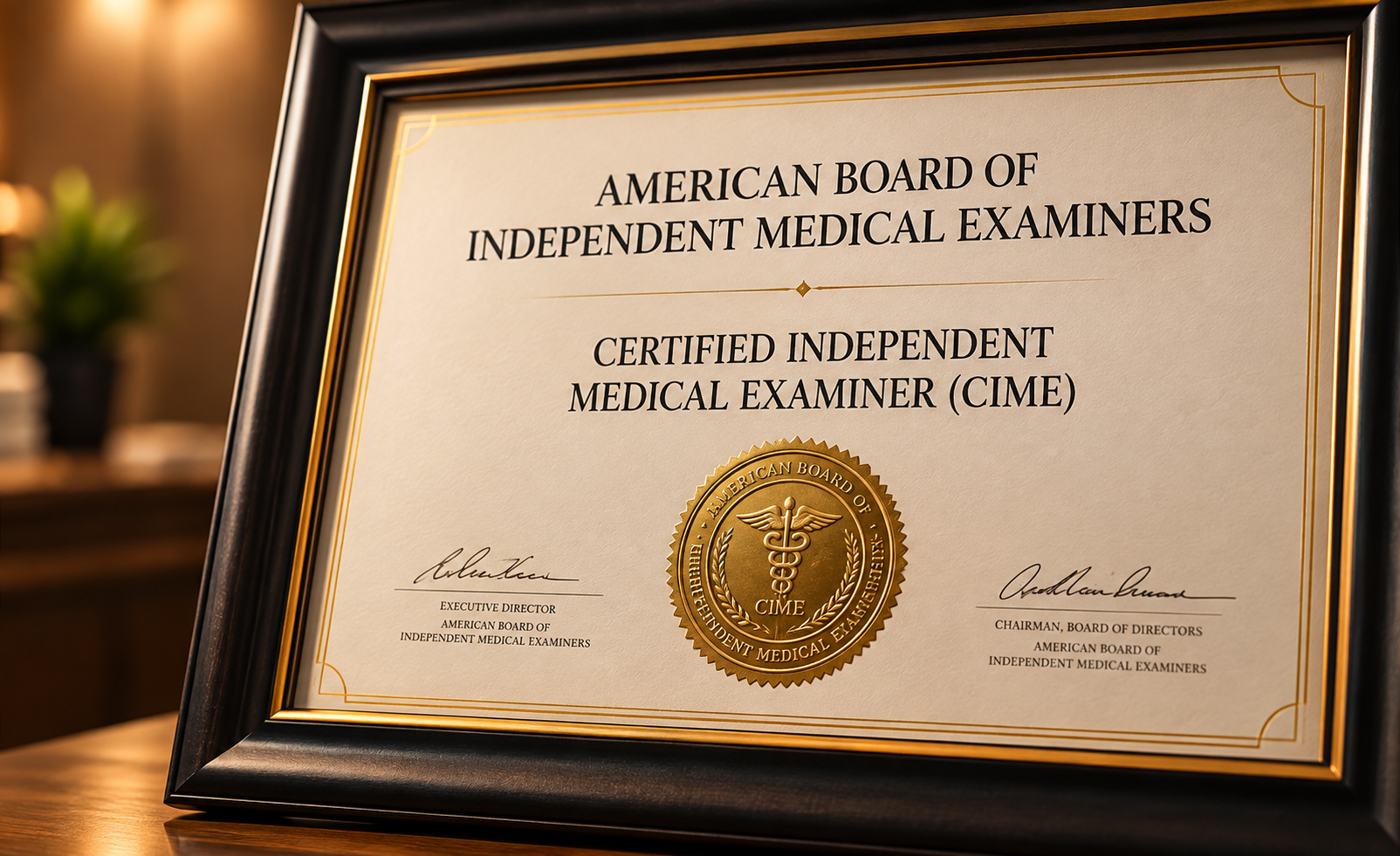

CIME CERTIFICATION: WHAT IT MEANS AND WHY IT MATTERS
A Certified Independent Medical Examiner (CIME) is a physician who has completed specialized training and certification through the American Board of Independent Medical Examiners (ABIME), demonstrating competency in the specific methodology, ethics, and documentation standards of medicolegal examination — distinct from clinical board certification alone.
Board certification (such as AOBOS for orthopedic surgery) confirms clinical competency in treating patients. CIME certification confirms competency in a different discipline entirely: conducting objective, legally defensible examinations, writing reports that withstand cross-examination, and understanding the medicolegal standards that govern IME work. Attorneys evaluating an IME provider should look for both — clinical expertise and CIME certification — since each addresses a different part of what makes a report credible in litigation.
Dr. Idema holds both AOBOS board certification and ABIME CIME certification, and is additionally SEAK-trained in medicolegal examination and expert testimony.

HOW AMA GUIDES IMPAIRMENT RATINGS WORK
Permanent impairment ratings in workers’ compensation and personal injury cases are typically calculated using the AMA Guides to the Evaluation of Permanent Impairment. Multiple editions remain in active use — the 4th, 5th, and 6th — and which edition applies depends on the jurisdiction and the specific statute governing the claim.
The Guides provide standardized methodology for translating a diagnosis and physical findings into a numerical impairment percentage, covering body systems from the spine to extremities. Because editions differ meaningfully in methodology (the 6th Edition, for example, uses a diagnosis-based approach that differs substantially from the range-of-motion methods common in earlier editions), using the correct edition for the jurisdiction is essential to a defensible rating.
Summit MedLegal Group applies the AMA Guides edition required by each jurisdiction — Florida, Ohio, Pennsylvania, West Virginia, Texas, Virginia, Illinois, and Georgia — ensuring impairment ratings are calculated correctly for the claim at hand.


DAUBERT VS. FRYE: WHAT ATTORNEYS NEED TO KNOW ABOUT EXPERT ADMISSIBILITY
Frye and Daubert are the two standards courts use to determine whether expert testimony is admissible. Frye (1923) asks whether the expert’s methodology is generally accepted in the relevant scientific community. Daubert (1993), used in federal courts and most states, applies a more rigorous multi-factor test: whether the methodology can be tested, has been peer-reviewed, has a known error rate, and is generally accepted.
An IME report that isn’t grounded in objective findings, established diagnostic criteria, and current evidence-based medicine is vulnerable to a Daubert or Frye motion — which can exclude the testimony before a jury ever hears it. A report built on a clear reasoning chain — objective exam findings, established diagnostic criteria, AMA Guides-based rating, and evidence-based conclusion — is built to withstand that challenge.
Dr. Idema’s reports are structured with Daubert/Frye admissibility in mind, and she is available for qualification support, deposition, and trial testimony.

IME VS. CME: UNDERSTANDING THE DIFFERENCE
An Independent Medical Examination (IME) is typically requested by an insurer, employer, or defense counsel in a personal injury or workers’ compensation case. A Compulsory Medical Examination (CME) is a court-ordered or statutorily mandated examination — common in certain states’ workers’ compensation systems, where the claimant is legally required to attend.
The distinction matters procedurally: a CME often carries different notice requirements, timelines, and consequences for non-attendance than a voluntarily requested IME. Jurisdiction-specific rules govern both, which is why working with an examiner familiar with the relevant state’s procedural requirements matters.
Summit MedLegal Group conducts both IMEs and CMEs across Florida, Ohio, Pennsylvania, West Virginia, Texas, Virginia, Illinois, and Georgia.